
Version: 1.0.0 | Published: 24 Mar 2026 | Updated: 184 days ago
Characterisation of hospitalised COPD exacerbations using real world data
Dataset
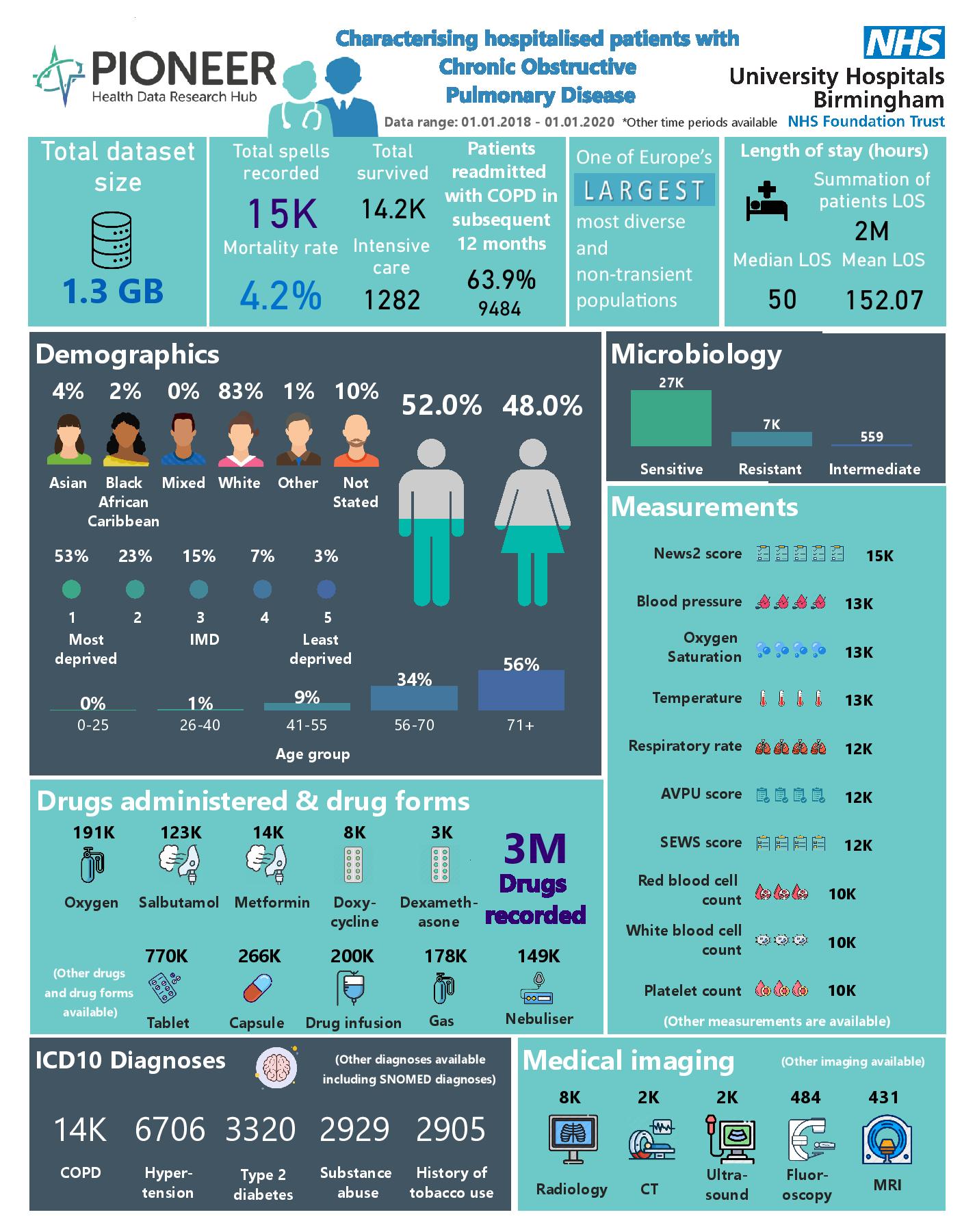
Summary
Description:
Chronic Obstructive Pulmonary Disease (COPD) patients admitted or using hospital services. Granular care pathways. Multi-morbidity, investigations, interventions, treatments. Serial physiology, blood biomarkers, physiotherapy, outcome. Deeply phenotyped.
Access Tier:
Controlled
Contact Point:
Health Theme:
- Noncommunicable diseases – metabolic & cardiopulmonary
- Respiratory infectious diseases
Health Category:
- Electronic Health Records (EHRs)
- Data from clinical trials, clinical studies & clinical investigations
Number of Unique Individuals:
14852
Documentation
Associated Media:
Documentation:
Chronic respiratory diseases remain one of the leading causes of death from non-communicable disease, with the majority of deaths due to Chronic Obstructive Pulmonary Disease (COPD). COPD presents a significant healthcare burden and is detrimental to quality of life. Currently, there are no disease modifying treatments.
Further to the burden of stable COPD, patients experience acute exacerbations (AECOPD), defined as an acute worsening of symptoms which requires a change in treatment. These are important events, associated with increased mortality, morbidity and long-term health impacts. Patients who exacerbate frequently are more likely to have a faster decline in lung function, have a lower quality of life and experience adverse cardiovascular events. Whilst there are therapies to reduce exacerbation frequency and treat the acute event, options have limited efficacy and have not changed in overall drug class for many years.
Exacerbations are defined by the severity of the symptoms and the treatments involved – so a severe exacerbation is one which requires hospitalisation. However, in our ageing and increasingly frail population, hospitalisation can be required for even a minor event, if a person is already struggling to cope at home.
PIONEER geography
The West Midlands (WM) has a population of 5.9 million & includes a diverse ethnic & socio-economic mix.
EHR. UHB is one of the largest NHS Trusts in England, providing direct acute services & specialist care across four hospital sites, with 2.2 million patient episodes per year, 2750 beds & an expanded 250 ITU bed capacity during COVID. UHB runs a fully electronic healthcare record (EHR) (PICS; Birmingham Systems), a shared primary & secondary care record (Your Care Connected) & a patient portal “My Health”.
Scope: All hospitalised patients admitted to UHB between January 2018 to January 2020 curated to focus on COPD exacerbations. Longitudinal & individually linked, so that the preceding & subsequent health journey can be mapped & healthcare utilisation prior to & after admission understood. The dataset includes highly granular patient demographics & co-morbidities taken from ICD-10 & SNOMED-CT codes. Serial, structured data pertaining to acute care process (timings, staff grades, specialty review, wards), presenting complaint, acuity, all physiology readings (pulse, blood pressure, respiratory rate, oxygen saturations), all blood results, imaging reports, all prescribed & administered treatments (fluids, blood products, procedures), all outcomes.
Available supplementary data: Matched controls; ambulance, synthetic data, differing time periods including/excluding COVID-19 pandemic periods.
Available supplementary support: Analytics, Model build, validation & refinement; A.I.; Data partner support for ETL (extract, transform & load) process, Clinical expertise, Patient & end-user access, Purchaser access, Regulatory requirements, Data-driven trials, “fast screen” services.
Coverage
Spatial
Spatial Coverage:
- United Kingdom
- England
- West Midlands
Temporal
Start Date:
01 January 2018
End Date:
01 January 2020
Frequency:
QUARTERLY
Date of Latest Release:
26 May 2021
Date of First Release:
08 October 2024
Temporal Aggregation:
1 - 10 Years
Provenance
Origin
Purpose:
Care
Collection Situation:
- Secondary care - Accident and Emergency
- Secondary care - In-patients
- Secondary care - Outpatients
Image Contrast:
Not stated
Method of Collection:
EPR
Access and Governance
Usage
Data Use Requirements:
Project specific restriction
Access
Jurisdiction:
- England
- Scotland
Data Controller:
University Hospitals Birmingham NHS Foundation Trust
Delivery Lead Time:
1-2 months
Legal Basis:
General research use
Health Data Access Body:
This publication uses data from PIONEER, an ethically approved database and
analytical environment (East Midlands Derby Research Ethics 20/EM/0158)
Format and Standards
Language:
English
Format:
SQL
Conforms To:
LOCAL
Coding System:
- SNOMED CT
- ICD10
- OPCS4
Data Distribution
Data Status:
Available
Distribution:
Trusted Research Environments (TRE) are built using Microsoft Azure services and
hosted in the UK to provide research teams a safe, secure and agile environment
which allows users to quickly analyse, interpret and form an enriched view of
primary care information through a range of integrated datasets. Health data
collated from multiple sources is ingested into a secure data lake which will
then allow subsets of data to be made available to research teams on approval of
a data request. Once approved a customer specific TRE is made available with a
standard set of leading analytical tools from Microsoft including Azure
Databricks, Azure Machine Learning, Azure SQL and Azure Synapse (for large-scale
data warehouses). Specific tools can be provided at an additional cost over the
standard platform data access charge and the PIONEER team will work with you to
determine your exact needs. Access to the TRE is managed using the latest
virtual desktop technology to provide a safe and secure end-user experience. By
utilising leading edge design PIONEER are able to create TREs rapidly to enable
us to service any customer requirement.,
www.pioneerdatahub.co.uk/data/data-services-costs/
Observations
Name
Population Type
Value
Description
Variable Measured
Unit Code
Observation Date
Number of Records
Minimum Typical Age
Maximum Typical Age
Persons
14852
14,852 Spells of hospitalised COPD exacerbations
Count
26 May 2021
14852
15
105
Origin
Name:
Data Catalogue