
Version: 1.0.0 | Published: 24 Mar 2026 | Updated: 184 days ago
Coagulopathies & arterial/venous thrombosis in COVID patients: an OMOP dataset
Dataset
Summary
Description:
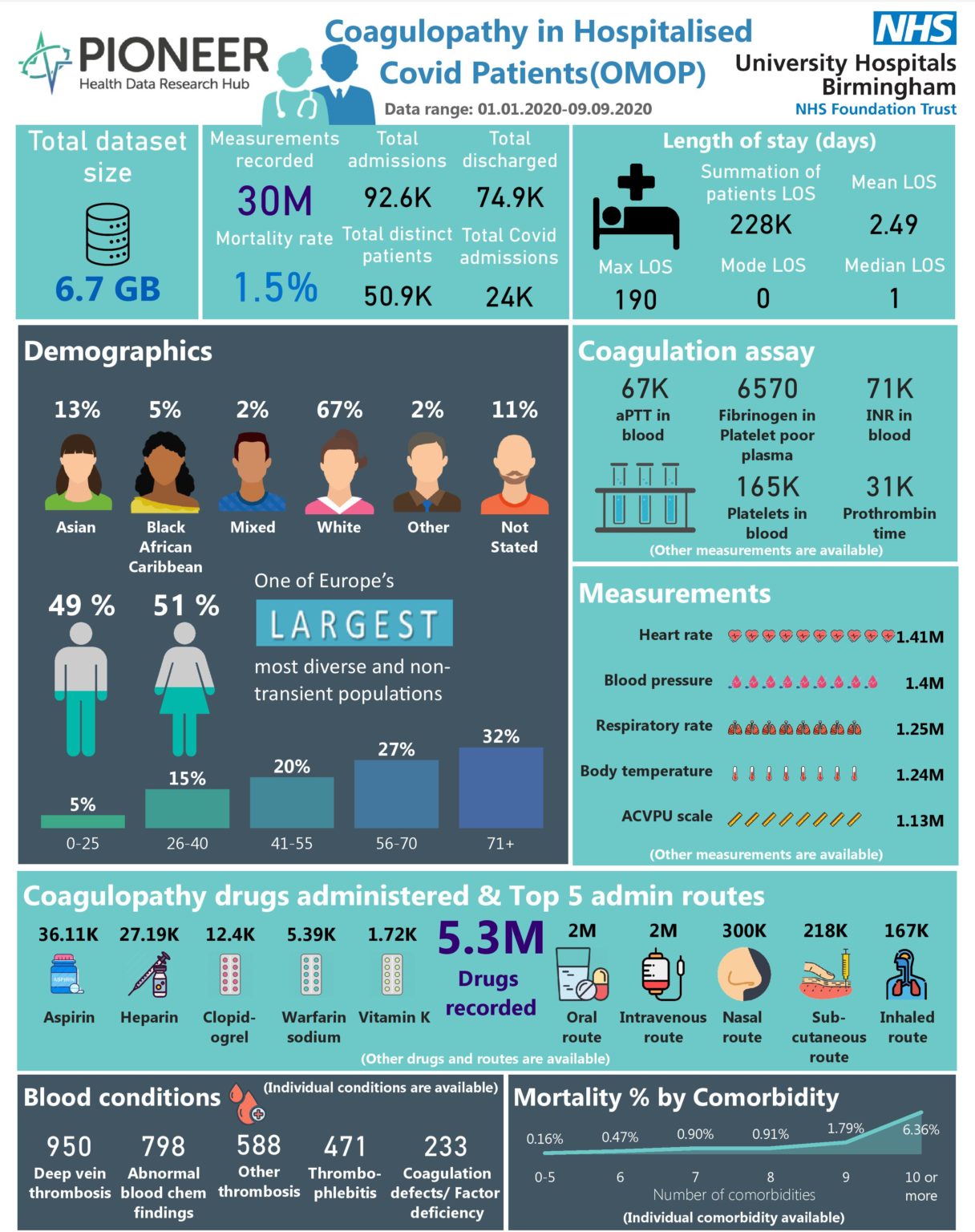
Hosp patients admitted during COVID pandemic with coagulopathies including venous thromboembolic events & bleeds. Granular condition, multi-morbidity, interventions & treatments. Serial physiology, blood biomarkers, ITU spells, outcome. Deeply phenotyped.
Access Tier:
Controlled
Contact Point:
Health Theme:
Noncommunicable diseases – metabolic & cardiopulmonary
Health Category:
- Electronic Health Records (EHRs)
- Data from clinical trials, clinical studies & clinical investigations
Number of Unique Individuals:
50899
Documentation
Associated Media:
Documentation:
In December 2019, the first case of severe acute respiratory syndrome coronavirus 2 (SARS-COV-2) was described and by March 2020, the World Health Organization had declared the disease (Coronavirus disease 2019, COVID-19) a pandemic. Whilst respiratory symptoms are the fundamental feature of the disease, evidence indicates that the disease is associated with coagulation dysfunction which predisposes patients to an increased risk of both venous and arterial thromboembolism (TE) and potentially increased mortality risk as a consequence. Biomarkers associated with TE (D-dimers) are often raised in people with COVID but without clear evidence of TE. It is important to understand who is at most risk of TE, to manage disease effectively. This dataset (in OMOP) describes patients with and without COVID who were admitted to UHB including all those with and without TE.
PIONEER geography
The West Midlands (WM) has a population of 5.9 million & includes a diverse ethnic & socio-economic mix. Birmingham was hard hit by all COVID waves and University Hospitals Birmingham NHS Foundation Trust (UHB) had >8000 COVID admissions by the end of December 2020.
EHR. UHB is one of the largest NHS Trusts in England, providing direct acute services & specialist care across four hospital sites, with 2.2 million patient episodes per year, 2750 beds & an expanded 250 ITU bed capacity during COVID. UHB runs a fully electronic healthcare record (EHR) (PICS; Birmingham Systems), a shared primary & secondary care record (Your Care Connected) & a patient portal “My Health”.
Scope: All patients admitted during the first wave of the COVID-19, both with and without COVID. The dataset includes highly granular patient demographics & co-morbidities taken from ICD-10 & SNOMED-CT codes. Serial, structured data pertaining to acute care process (timings, staff grades, specialty review, wards), presenting complaint, SARS-CoV-2 swab result, diagnosis of TE, clotting parameters, D-Dimers, acuity, all physiology readings (pulse, blood pressure, respiratory rate, oxygen saturations), all blood results, imaging reports, all prescribed & administered treatments (fluids, antibiotics, inotropes, vasopressors, organ support), all outcomes.
Available supplementary data: Matched controls; ambulance, synthetic data.
Available supplementary support: Analytics, Model build, validation & refinement; A.I.; Data partner support for ETL (extract, transform & load) process, Clinical expertise, Patient & end-user access, Purchaser access, Regulatory requirements, Data-driven trials, “fast screen” services.
Coverage
Spatial
Spatial Coverage:
- United Kingdom
- England
- West Midlands
Temporal
Start Date:
01 January 2020
End Date:
08 September 2020
Frequency:
STATIC
Date of Latest Release:
11 August 2020
Date of First Release:
08 October 2024
Temporal Aggregation:
0 - 6 Months
Provenance
Origin
Purpose:
Other
Collection Situation:
- Secondary care - Outpatients
- Secondary care - In-patients
- Community
Image Contrast:
Not stated
Method of Collection:
EPR
Access and Governance
Usage
Data Use Requirements:
Project specific restriction
Access
Data Controller:
University Hospitals Birmingham NHS Foundation Trust
Delivery Lead Time:
1-2 months
Legal Basis:
Research use only
Health Data Access Body:
This publication uses data from PIONEER, an ethically approved database and
analytical environment (East Midlands Derby Research Ethics 20/EM/0158)
Format and Standards
Language:
English
Format:
SQL
Conforms To:
OMOP
Coding System:
- SNOMED CT
- ICD10
Data Distribution
Data Status:
Available
Distribution:
Trusted Research Environments (TRE) are built using Microsoft Azure services and
hosted in the UK to provide research teams a safe, secure and agile environment
which allows users to quickly analyse, interpret and form an enriched view of
primary care information through a range of integrated datasets. Health data
collated from multiple sources is ingested into a secure data lake which will
then allow subsets of data to be made available to research teams on approval of
a data request. Once approved a customer specific TRE is made available with a
standard set of leading analytical tools from Microsoft including Azure
Databricks, Azure Machine Learning, Azure SQL and Azure Synapse (for large-scale
data warehouses). Specific tools can be provided at an additional cost over the
standard platform data access charge and the PIONEER team will work with you to
determine your exact needs. Access to the TRE is managed using the latest
virtual desktop technology to provide a safe and secure end-user experience. By
utilising leading edge design PIONEER are able to create TREs rapidly to enable
us to service any customer requirement.,
www.pioneerdatahub.co.uk/data/data-services-costs/
Observations
Name
Population Type
Value
Description
Variable Measured
Unit Code
Observation Date
Number of Records
Minimum Typical Age
Maximum Typical Age
Persons
50899
50,899 patients including Coagulopathy and Non-Coagulopathy control group.
Count
09 December 2020
50899
18
110
Origin
Name:
Data Catalogue